I hope you enjoy reading this blog post. If you want us to just build your AI agents for you, click here.
Say your estimators leave 400 unsold quotes sitting in the CRM this quarter. Your office calls each one once, gets voicemail on most, and moves on to the inbound line.
Our call data says that single call misses about half the homeowners you could have reached. A lot of quote follow up advice online is one email template and a reminder to “check in,” which skips the hard part: reaching a person at all.
Key Takeaways
- 22% of 828 quote requests reached a live person on an AI follow-up line’s calls, so a 400-quote list yields about 88 conversations.
- 49% of those people (89 of 183) only answered on calls two through six. A one-call policy leaves roughly half of them behind.
- Only 5.7% of quote requests that hit voicemail (36 of 635) called back within 7 days. Waiting for the homeowner to call back is a weak plan.
- A second dataset of 13,310 calls found 24% answered live and about 9 in 1,000 dials ended in a transfer to a sales rep.
- Run 6 touches over about a week: five or six calls, two texts, two emails. The cadence, a tracking setup and a full template kit are below.
- These are online quote requests, not in-home estimates. A presented estimate is warmer, so test the cadence before copying it.
What 828 Quote Requests Show About Following Up
Start with the source, because it limits what the numbers can say.
The first dataset is a roofing contractor’s AI follow-up line calling online quote requests that had gone quiet. The cohort is 828 quote requests first dialed from Sep 29 to Oct 3, 2026, followed through Oct 13, 2026. The line placed 3,333 dials, usually 5 or 6 attempts per request over about a week to 10 days.
The results:
- 183 of the 828 (22%) reached a live person on one of the agent’s calls.
- 94 of those 183 (51%) picked up on the first call.
- 89 (49%) picked up only on calls two through six: 36 on call 2, 21 on call 3, 19 on call 4, 10 on call 5 and 3 on call 6.
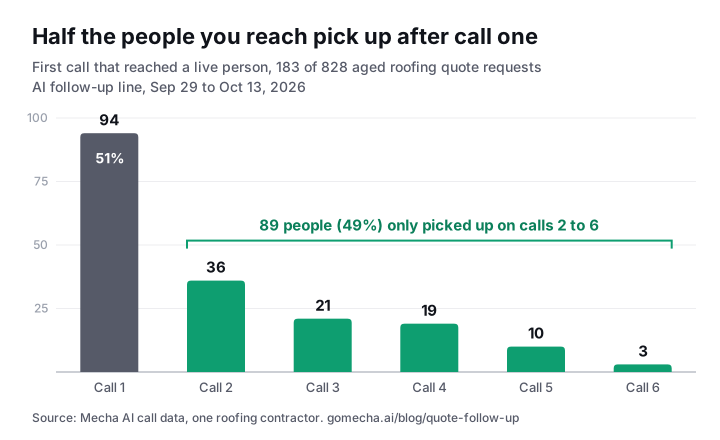
Nearly as many people answered after the first call as on it.
Now apply it. Your list has 400 unsold quotes. At 22%, you reach about 88 people. Call once and you talk to about 45 of them. The other 43 or so only pick up on a later try.
The Voicemail Pile Rarely Calls Back
If a call hits voicemail, many shops wait for the callback. In the same cohort, 635 of the 828 had at least one call go to voicemail. Of those 635, 36 (5.7%) called the line back within 7 days.
Twenty-six of the people who called back had never been reached on an outbound call. Counting those callbacks, contact rose from 22% to 25% of the list (209 of 828).
So the callback is real, and it is small. Treat it as a bonus on top of the next attempt.
A second contractor shows the same shape at larger volume. In 21 days ending Jun 12, 2026, an outbound AI agent placed 13,310 follow-up calls to aged online quote requests for a home-improvement contractor. About 24% were answered live (3,208), 69% went to voicemail (9,134), and about 9 of every 1,000 dials ended in a live transfer to a sales rep (121).
Most dials hit voicemail. With that much voicemail, each person needs several dials.
How to Follow Up on a Quote: A Six-Touch Week
This is how to follow up on a quote when you take the data seriously. It is my suggested cadence, built to match the line above (usually 5 or 6 call attempts over about a week). Text and email timing varies by industry, so treat those as a starting point.
The same cadence answers how to follow up on a quote request that came in through a web form or a lead vendor. The clock starts when the request lands.
| Day | Touch | Purpose |
|---|---|---|
| 0 | Call | Reach them while the quote is fresh. Leave a voicemail. |
| 1 | Call, then text | Different time of day than Day 0. Text if no answer. |
| 2 | Call | Third attempt, a third time of day. |
| 3 | Call, then email | Email carries the quote detail and one clear next step. |
| 5 | Call, then text | Ask one question about timing. |
| 7 | Call, then email | Close the loop with a last, friendly message. |
Three rules keep the week clean:
- Vary the time of day on each call: try morning, lunch and early evening.
- Stop the sequence the moment someone answers, books or says no.
- Log every attempt in the CRM so the next person sees the history.
Run the calls and, going by the roofing line, a 400-quote list produces about 88 conversations. One call gets you about 45.
-> Curious how many calls your own team never gets to? Run the free Phone Leak Analyzer and see the number in about a minute.
A Follow-Up System That Runs Without Heroics
A cadence on a whiteboard dies by Thursday. A quote follow up system turns it into fields and rules, so the next touch is always visible.
This is my design for any CRM with custom fields, a task queue and a saved view. A spreadsheet works too.
| Field | What it holds | Rule it drives |
|---|---|---|
| Quote status | Open, in sequence, booked, lost, closed | Only “in sequence” quotes get touches. |
| Attempt count | Calls made so far | Stop calling after the last scheduled call. |
| Last-attempt time | Date and hour of the latest call | Next call goes at a different time of day. |
| Next-attempt date | The day the next touch is due | The queue shows today’s due quotes, oldest first. |
| Outcome code | Reached, booked, lost with reason, wrong number, opted out | Every attempt ends in exactly one code. |
Two outcome codes carry rules of their own. “Lost with reason” records price, timing, another company or no project. “Opted out” removes the quote from every channel the same day.
Read two numbers every Monday:
- Share of quotes reached. Quotes with at least one “reached” outcome divided by quotes that entered the sequence. Compare it to the 22% above.
- Attempts per reach. Total call attempts divided by quotes reached. If it climbs, your call times are wrong or your list is stale.
If you paid for the quote requests, add a third line: the spend per request.
Quote Follow Up Email Templates, Texts and Call Scripts
Copy the pieces below and replace the bracketed words. Aim each message at a single reply.
The call opener
When someone picks up, borrow the structure of the opener in our unsold estimate follow-up script. It names the exact quote, asks if they have questions, then asks what is holding them back: price, timing or comparison shopping.
A call script works when the caller sounds like the person who wrote the quote. Name the job, ask one question and then stop talking.
The 20-second voicemail
Keep it under 20 seconds and say your number twice.
Hi [NAME], it’s [YOUR NAME] at [COMPANY]. I’m calling about the [SERVICE] quote for [ADDRESS OR SCOPE]. I have one question about timing. Call or text me back at [PHONE]. That’s [PHONE]. Thanks.
The text (Day 1 and Day 5)
A quote follow up text gets read in minutes, so it carries one question and a choice of two times.
Hi [NAME], it’s [YOUR NAME] at [COMPANY]. I tried you about the [SERVICE] quote. Is [DAY] or [DAY] better for a quick call?
For Day 5, change the question to timing:
Hi [NAME], [YOUR NAME] at [COMPANY] again. Is the [SERVICE] still planned for [MONTH]? A one-word reply is fine and I will plan around it.
Text only numbers that agreed to texts on your quote form, and log that consent. This isn’t legal advice; check the wording with your attorney.
The Day 3 email
This is the quote follow up email template to start with. It also works as a follow up email after quote delivery when you could not get the homeowner on the phone.
Subject: Your [SERVICE] quote
Hi [NAME],
I called about the [SERVICE] quote for [ADDRESS OR SCOPE] and missed you. The quote is attached again.
Two quick questions. Is the timing still [MONTH]? And is anything about the price or scope worth a second look?
Reply with a time that works and I will call then.
[YOUR NAME], [COMPANY]
The follow-up email after no response (Day 7)
This follow-up email after no response sample goes out after several calls and one earlier email went unanswered. It is shorter, names the gap and makes a reply cheap.
Subject: Still planning the [SERVICE]?
Hi [NAME],
I have called a few times about the [SERVICE] quote and have not caught you. That is normal this time of year.
Reply with 1, 2 or 3 and I will take it from there:
- Still interested, call me on [DAY].
- Need to change the scope or price.
- Plans changed, close it out.
[YOUR NAME], [COMPANY], [PHONE]
The close-the-file email (Day 10 to 14)
Send this one as the last touch after the week is over. It gives the homeowner an easy way to say yes or no, and it ends the thread politely.
Subject: Should I close your file?
Hi [NAME],
I am wrapping up open quotes for the [SEASON] schedule, and yours for the [SERVICE] is still on my list.
Should I keep it open or close the file? Either answer is fine. A one-word reply works.
If you want to revisit it later, reply any time and I will pick it back up.
[YOUR NAME], [COMPANY]
What to say instead of “just checking in"
"Just checking in” gives the homeowner no reason to answer. Each opener below carries a reason to reply, which is also the polite way to follow up.
- The quote detail: “I reread the scope on your [SERVICE] quote and had one question about [ITEM].”
- A timing question: “Is the [SERVICE] still planned for [MONTH], or has that moved?”
- A price question: “Was the price in line with what you expected, or higher than you hoped?”
- A scope question: “Would a smaller version of the job fit better? I can requote it today.”
- A schedule reason: “My [SEASON] schedule fills up by [DATE]. Should I hold a spot for you?”
Estimate Follow Up When a Rep Already Presented
This data has a limit. Those 828 people filled out an online form. No rep had stood in their kitchen or on their roof.
A presented estimate probably runs warmer. The homeowner has met a named person, seen a number and heard the scope. That may mean fewer attempts reach the same share of people, or faster replies to a text from the rep they know. I have no number for that, and the 828 cohort cannot supply one.
My read, labeled as opinion: for a presented estimate, keep the six-touch week and put the rep’s name on the text and email. Then measure how many attempts it takes on your list.
The same approach covers how to follow up on unsold estimates from last quarter. Restart with the Day 7 email. An estimate follow up email works best when it names the job and one detail the homeowner will recognize.
If your pile is older, the same logic applies to customer reactivation, where the list is cold and the opener names a past project. For brand-new web leads, the speed matters more than the cadence, which is what speed to lead covers.
Who Makes All Those Calls
The six-touch week works on paper. On a real Tuesday your CSRs are on the inbound line, and the 400-quote list loses to the ringing phone.
That is where an AI line earns its keep. Outbound follow-up calls every unsold estimate on the cadence you set, has a real conversation, books the job and hot-transfers anyone who wants a person. Our post on automation workflows for contractors touches on the same unsold estimate gap.
Check your own answer rates first. If your team already works the list with discipline, keep doing it.
Follow-Up Questions Contractors Ask
How do I follow up for a quote?
Call the same day, then follow the six-touch week above.
Add a text on Day 1 and an email on Day 3. Stop the moment the homeowner answers.
How do you professionally follow up on an estimate?
Name the job, ask one specific question and offer two times.
Skip “just checking in.” Use one of the openers above.
What is a good follow-up message?
A good message is two or three short sentences with one question.
It names the quote, asks about timing, scope or price, and makes a one-word reply possible.
How do you say follow up politely?
Give a reason to reply and an easy way to decline.
“Should I close your file?” does both. The homeowner can say yes, no or later.
How long should you wait to follow up on a quote?
Call the same day the quote goes out.
The roofing line kept calling for about a week. Waiting for a callback worked for only 5.7%.
The Final Word
The data points to one change: reach each homeowner more than once. A quote follow up plan with one touch is a plan to talk to about half the people you could.
- Count your unsold quotes and multiply by 22% for a rough conversation target.
- Plan 5 or 6 calls over about a week, at different times of day.
- Add a text and an email so voicemail does not end the thread.
- Log every attempt, then compare your numbers to the cohort above.
Somebody already paid to get each of those quote requests, and what each request cost you to generate is worth knowing. Reaching the person behind it takes a few more calls.
-> Want to hear a follow-up call before you plan yours? Call Jill, our voice AI agent. She answers questions about how Mecha handles outbound follow-up for contractors.