I hope you enjoy reading this blog post. If you want us to just build your AI agents for you, click here.
Standard Energy Solutions is a leading solar installation + services company HQ’d in Maryland. They do over 100 new solar projects a month, along with maintenance + service for their 5,000+ residential customers.
The Problem
As revenues grew, so did call volumes. And their current system was no longer cutting the mustard.
They’d cycled through a couple different answering services in a few years + were unfortunately still frustrated.
“We trained + then RE-trained their teams at least half a dozen times. Mistakes continued.”
The service could rarely do more than take a message. They were overwhelmed with service tickets. And those tickets often went to the wrong person or team!
AI looked promising. Their inboxes were full of pitches. But after 2 bad vendor relationships, they didn’t know who to trust.
They needed a low-risk way to test into a better solution.
The Approach
The executive team stumbled upon some of our content on LinkedIn. They realized we’re right in their neighborhood + decided to give us a shot.
But with a small caveat.
Instead of taking over 100% of calls on day 1, we decided to run on the service line only first. That meant a stream of relatively uniform caller types (i.e. known customers with installed systems) + gave us a chance to dip a toe in the water, experiment, learn + perfect.
The service line took its first calls in late June 2026.
For about six weeks the agent ran there alone while we audited live calls + fixed what we found.
By August 3, the confidence was there. The main front desk agent went live.
And we’ve answered every inbound call since.
“Working with Mecha has been an absolute breath of fresh air.”
Steve Welsh, CEO, Standard Energy Solutions
The Solution
There were quite a few caller types once we expanded to the front desk. And different flows within caller types that all had to be included in the prompts. The token count was getting higher than we like.
So we ultimately decided to break out the flow across smaller agents that hand work to each other.
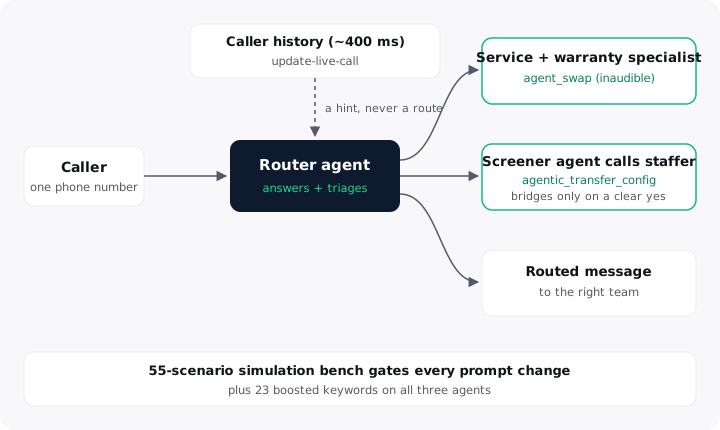
- A router answers every call, triages + decides the path.
- A specialist takes service + warranty callers via an inaudible
agent_swap. It is the same agent that proved itself on the service line. - A screener phones the right person internally first on any warm transfer, using Retell’s
agentic_transfer_config. (E.g. “I have John on the line from ABC Supply, do you want the call?” before just transferring cold.)
The Router + the Inaudible Agent Swap
The router triages + then takes one of three paths: a live transfer, an agent_swap for service + warranty callers, or a routed message. It does the job a customer service and dispatch agent does for a contractor, split across specialists.
The swap is silent. The router begins with a blank begin message, says one empathetic line + never says “let me transfer you.” The caller hears a continuous conversation while a specialist agent with its own prompt takes over behind the scenes.
Screened Warm Transfers
A warm transfer means a person hears who is calling before the call connects. Retell’s agentic_transfer_config runs this step with a separate screener agent built as a Retell conversation flow.
The screener answers the staffer first + states who is calling. It bridges the caller only on a clear yes. It recognizes call-screening services + recordings + keeps the caller off them. If the staffer wants something passed along, the screener relays those words back to the waiting caller.
Each department line is its own predefined tool. The agent chooses a tool by name + no tool holds a number it could mix up, so dialing the wrong line is structurally impossible.
Memory After the Webhook
Retell’s call_inbound webhook has a hard 10-second limit, so the history lookup runs after it responds. The workflow retrieves the caller’s history in about 400 ms + pushes it into the live call with Retell’s update-live-call.
The router still decides the route from what the caller says. History is a hint, never a forced path, so a stale note cannot send anyone to the wrong department.
The Simulation Bench + Boosted Keywords
Every prompt change must clear a simulation bench before it goes live. The first version held 26 scenarios + passed 69.2% of them. Nine rounds of fixes later it passed 96.2%. The bench now holds 55 scenarios.
Speech recognition got the same data-first treatment. One staffer’s name was spelled six ways across 887 calls + the correct spelling was the rarest. Retell’s boosted keywords tell the speech recognizer which words to favor, so we built a list of 23 from the spellings in the call log + applied it to all three agents.
Four Months of Iteration
The three agents have shipped more than 50 published versions since June. Each one was a small, dated change + many came straight out of a live-call audit. The highlights:
| When | What changed | Retell feature |
|---|---|---|
| Late June | Service line goes live for known customers only | Retell LLM agent |
| Early July | First audit fixes: a local-time clock + caller details at call start | call_inbound dynamic variables |
| Mid July | Agent learns to recognize hand-offs from the outgoing answering service during the overlap | Prompt + live-call audit |
| July 30 | Front-desk router built, with the service agent as its swap target | agent_swap, agentic_transfer_config |
| August 3 | Bench drives the router from 69.2% to 96.2%; seven transfer tools built from the client’s real lines | Simulation testing, predefined transfer tools |
| August 4 | Client acceptance testing on silence + hold handling, then the front desk goes live | Silence reminder settings |
| August 19 | One post-call schema across agents: call outcome, issue category, asked for a human, Spanish speaker | Post-call analysis fields |
| August 21 | Spanish on the service line | Multilingual support |
| September 4 | Screener rebuilt: any clear yes bridges, plus a hold branch for call-screening services | Conversation flow |
| September 10 | 23 data-derived boosted keywords on all three agents | Boosted keywords |
| October 1 | Caller memory, plus a two-strike rule for a bad transfer line | update-live-call |
| October 19 | Release from the October audit: caller history by default, tighter rules on what the agent promises | Versioned publish |
Retell’s versioning made this pace safe. Every change shipped as a new published version with its own notes + the agents point at exact versions of one another, so a fix to one agent reached another only when we re-pinned it on purpose.
Retell Features in This Build
| Retell feature | What it does in this build |
|---|---|
agent_swap | Hands service + warranty callers to a specialist agent without an audible transfer |
agentic_transfer_config | Runs a screener agent that phones the staffer, asks for a clear yes + relays their words back |
| Conversation flow | Powers the screener’s fixed steps + its hold branch |
| Predefined tools | Give each department line its own tool so the agent cannot dial the wrong one |
update-live-call | Pushes the caller’s history into the call after the inbound webhook responds |
call_inbound webhook | Starts every call with the server, inside Retell’s 10-second limit |
| Post-call analysis | One shared set of structured fields on every call for reporting |
| Simulation testing | Runs the 55-scenario bench on every prompt change |
| Boosted keywords | Favors data-derived spellings on all three agents |
| Agent versioning | Pins each agent to exact versions of the others |
Results
Week one on the front desk: 49 of 49 calls routed correctly. The main line took its first real traffic on August 13. Our first-week audit checked every call, + each one reached the right team as a complete ticket.
Every call gets answered. No voicemail, no hold queue, at any hour.
In the last 30 days (September 29 to October 28, 2026) the two lines took 403 calls longer than five seconds. 265 were real callers. The rest were spam, robocalls + hang-ups. Here’s what the real callers wanted:
| Caller intent | Calls | Share |
|---|---|---|
| Service + warranty | 128 | 48% |
| Reach a specific person | 29 | 11% |
| Other | 27 | 10% |
| Partners + vendors | 15 | 6% |
| Billing + accounts | 14 | 5% |
| New sales inquiry | 11 | 4% |
| Scheduling | 11 | 4% |
| Upgrades + expansion | 9 | 3% |
| Permits + inspections | 7 | 3% |
| Commissioning + activation | 6 | 2% |
| Ownership transfer | 6 | 2% |
| Spanish speaker | 2 | 1% |
A dozen intents, several departments, one phone number. That’s the routing problem the three agents exist to solve.
Messages are still most of the job. Under the answering service, about 75% of calls ended as a message for the team to return. Today about 66% do, a 12% drop.
The bigger change is the message itself. With the answering service, tickets were thin + often landed with the wrong person or team. Now every message is a structured ticket (who called, what they need, the issue category + whether they asked for a person) sent to the team that owns it. The right person gets a complete, correct ticket.
What We’d Tell Another Builder
- Start on an isolated line. Known customers on a service line gave us six weeks of real calls before the front desk moved over.
- Put slow work after the
call_inboundresponse. Memory + CRM lookups can go throughupdate-live-callor a mid-call custom function. - After an
agent_swapwithwebhook_setting: only_destination_agent, the post-call webhook fires at the destination agent while the call keeps the source agent’s ID. Design post-call fields so both agents share the ones you report on. - Count the spellings in your own call log before you pick boosted keywords.
- Treat memory as a hint. Let the caller’s words choose the route.
A single-line shop with one person taking every transfer needs none of this. One phone, one destination + one voice leave nothing to route, screen, or swap. This design earns its place when several departments share a number + the cost of a wrong transfer is high.
The Final Word
- Lower the risk first: one isolated line, known callers, then the front desk.
- Split the front desk by job: one agent routes, one specializes, one screens.
- Ship small, versioned changes from live-call audits + gate every one on a bench.
The result is a front desk that was trained once, can be molded for new campaigns + routes correctly at scale.
→ Wondering what a front desk like this would do with your calls? Call Jill, our voice AI agent. She answers questions + explains how Mecha works.